Security Company Growth
How to Evaluate a Mobile Panic Service as a New Revenue Stream
A practical business case for security owners: calculate contribution, test operational capacity and measure a pilot before offering mobile panic subscriptions.
Published by Omega Panic Grid ·
In this guide
Start with a service you can actually deliver
A mobile panic service can give an existing customer another reason to stay connected to a security company. That is a commercial opportunity, not evidence that an app will automatically increase sales or reduce cancellations. The useful question is whether your company can offer a clearly defined, adequately staffed service at a price customers will accept.
For a South African operator, the starting point is its own service area, control-room arrangements and response capability. A branded interface does not create additional vehicles, replace an operator or extend a response agreement beyond its stated boundaries. Build the commercial proposal around the service you can resource today.
Separate three costs before setting a price
Treat the platform licence, the cost of handling alerts and the cost of delivering response as separate items. The platform is a supplier expense. Operator time, training and customer support remain operating expenses. Vehicle availability, fuel and any contracted response charges belong in the service model too.
An offer described as a simple add-on may still generate onboarding questions, accidental alerts and out-of-area requests. Estimate these workloads rather than assigning them a zero cost. Ask the platform supplier which user limits, support arrangements and charges apply, then confirm them in the quotation.
Use a contribution model, not a revenue promise
Consider a hypothetical pilot with 100 paying customers at R100 each per month. Gross monthly receipts would be R10,000 before tax treatment, fees, discounts or non-payment. Suppose, purely for illustration, platform and incremental operating expenses together total R6,000. The remaining R4,000 is contribution before overheads and tax, not a guaranteed profit.
Those numbers are not Omega pricing or a customer result. Replace every input with your quotation, actual payment costs and a measured estimate of the work involved. A useful break-even calculation divides fixed incremental costs by the amount left from each collected subscription after variable costs. If that remaining amount is zero or negative, adding customers will not repair the model.
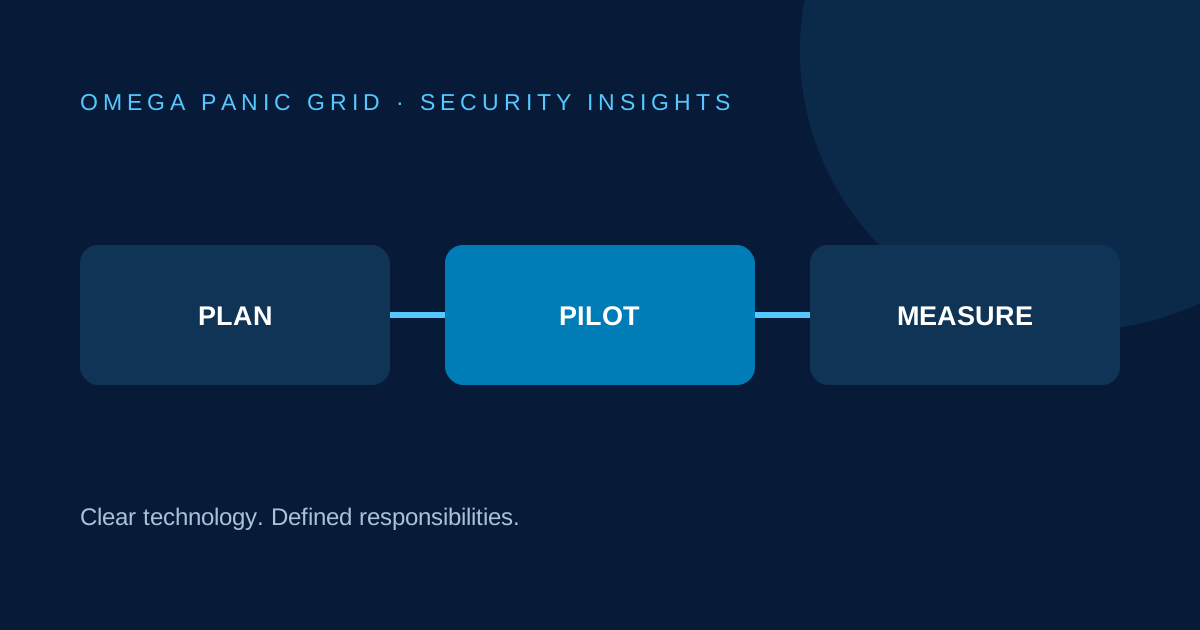
Design a small, measurable pilot
Choose a limited group whose needs match your existing coverage. Agree the service hours, who receives alerts, the escalation route and how tests are identified. Give customers a short demonstration and record whether they can reach the correct monitoring team. Do not test by sending unannounced alerts into a live response queue.
Measure activation completion, support minutes per customer, the number of accidental or test activations, cancellation reasons and collected revenue. A weekly review with the control-room supervisor is more useful than counting downloads alone. Customer retention should be measured over time against your own baseline; do not assume an improvement because an app has been launched.
Check readiness alongside the sales plan
PSiRA’s consumer guidance encourages verification of security businesses and officers. Buying software is not a substitute for checking the registrations and professional arrangements relevant to the service being offered. The applicability of particular requirements depends on the activity; confirm uncertainties with PSiRA or an appropriate adviser.
Also review how customer identity, contacts and alert information will be handled. The Information Regulator identifies information-officer responsibilities including a compliance framework and impact assessment. These are governance tasks, not a badge a software supplier can confer. Agree responsibilities and obtain appropriate advice for your arrangement.
Where Omega Panic Grid fits
Omega Panic Grid’s existing website offers white-label branding, a mobile SOS and a control-room workflow illustrated through acknowledgement, contact, dispatch and resolution. The website’s sign-up form starts an enquiry; it does not activate an operational subscription. The participating organisation remains responsible for monitoring and response.
Use the current pricing section and a written quotation for the platform cost in your model. Ask about your expected users, service area and support arrangements. Then run the pilot before committing to a wider launch. The strongest commercial case is an evidence-based service plan, not the promise of effortless recurring income.
Check current platform packages · Review the branded-service launch checklist
Continue your research
- Current platform pricing
- Interactive platform demonstration
- Setup and quotation enquiry
- Panic button software for security companies
References and product evidence
- PSiRA — Consumer awareness and provider verification
- Information Regulator — POPIA and information-officer guidance
- Omega Panic Grid — platform, pricing, demonstration and onboarding
Sources reviewed 1 November 2026. General planning guidance, not legal or medical advice. No response time, delivery or business return is guaranteed. Confirm current product and contractual details for your deployment.