White-Label Security Solutions
What to Check Before Launching Your Own Branded Panic Service
A buyer’s checklist for a white-label panic service: branding, user invitations, monitoring responsibility, supplier terms, subscription costs and launch testing.
Published by Omega Panic Grid ·
In this guide
White-label branding is a starting point
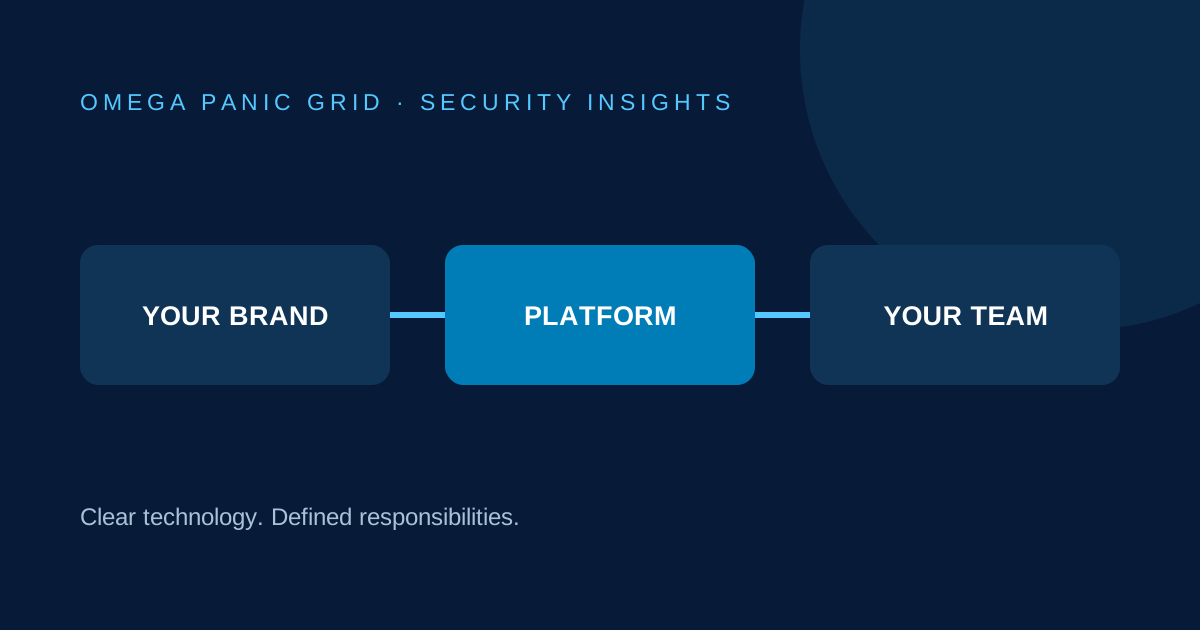
A white-label panic platform lets a participating organisation offer an interface under its own identity while a supplier provides the underlying technology. It can reduce the need to develop software from scratch. It does not remove the work of defining the service, onboarding customers or maintaining an operational response arrangement.
Before comparing logos and colours, write down the service you intend to sell. Is it monitored by your own control room? Does a contracted provider handle response? What area and hours are covered? These answers determine the offer more than the appearance of the button.
Ask what the branding package actually includes
Confirm which name, logo, background and contact details can be configured. Ask to see the customer interface and the monitoring workflow. Do not infer app-store distribution, custom development, APIs, wearable support or third-party integrations from the phrase white-label alone.
The existing Omega Panic Grid website demonstrates company branding, a red SOS interface and a direct control-room call concept. Its operational proposition includes a monitoring console and location-assisted response coordination. Confirm the precise delivery format, supported devices and account capabilities in your quotation and onboarding discussion.
Understand invitation and activation separately
A company-specific invitation or registration route should connect a customer to the intended organisation. Establish who issues it, who supports registration and how expired or misdirected invitations are dealt with. Do not confuse customer onboarding links with public affiliate referral links; the two have different purposes.
Omega’s published onboarding process starts with an enquiry and quotation, followed by agreement and payment confirmation, then an invitation and setup. Submitting the marketing website’s form is not operational activation. Agree a controlled test with the monitoring team before enrolling a wider customer group.
Make the subscription economics explicit
Ask how platform charges are calculated, what counts as a registered user and what happens when the next package boundary is crossed. Use the current website pricing and the written quotation rather than copying an old social post. Confirm applicable tax, setup charges, support scope and billing terms.
Your resale price is a separate decision. Collected subscription revenue must cover platform costs and the operating service you promise. A customer who pays for access to a branded interface may also expect support and response. Price that work honestly; gross receipts are not net profit. This guide deliberately avoids freezing wholesale prices into an article that may outlive the current quotation.
Put responsibility and evidence in the agreement
Clarify who provides monitoring, response, customer support and incident-record access. Ask what evidence will be available to investigate an alert and what happens if connectivity or a device permission is unavailable. Do not promise uninterrupted delivery, a fixed response time or exact GPS precision without a substantiated service commitment.
PSiRA regulates the private security industry; a software purchase is not itself proof of registration or approval. Verify the providers relevant to the arrangement and obtain advice on contractual and data-handling responsibilities. Never describe Omega as PSIRA-approved unless an applicable, verified basis has been established.
Keep affiliates distinct from service operators
Omega’s separate affiliate programme currently describes a default R500 once-off reward for an eligible new organisation after verified payment, activation and the programme’s review and approval conditions. A click, enquiry or unpaid registration does not earn it. The current terms govern participation, attribution and payout eligibility.
An affiliate is an introducer, not automatically a monitoring operator, responder or authorised representative. If your main aim is to launch a branded service, start with the product enquiry and demo. If you want to introduce an organisation, read the affiliate terms and apply through that programme. Keeping these routes distinct avoids promising customers a service an introducer does not provide.
Read the current affiliate terms · Build a commercial feasibility model
Continue your research
- Current platform pricing
- Interactive platform demonstration
- Setup and quotation enquiry
- Panic button software for security companies
References and product evidence
- PSiRA — Consumer awareness and provider verification
- Omega Panic Grid — platform, pricing, demonstration and onboarding
- Omega Panic Grid — affiliate programme terms
Sources reviewed 1 November 2026. General planning guidance, not legal or medical advice. No response time, delivery or business return is guaranteed. Confirm current product and contractual details for your deployment.